
How to Play Hula Balua - Step-by-Step Guide
Hula Balua is more mechanically complex than most cluster slots. This guide walks through everything a new player needs: understanding the 6×6 grid, how wins form, how merges compound the multiplier, how the bonus triggers and upgrades, and what decisions you can make to manage a session effectively.
Contents
Before You Start Playing
Hula Balua is a high-volatility slot. This means it is not suitable for first-time slot players who are unfamiliar with the concept of extended cold runs - sessions where many spins produce no significant wins. Before investing real money, it is worth spending time in the free demo version to understand how the game's mechanics feel over a realistic number of spins.
The free demo on this site runs the same game engine as the real-money version. Every mechanic - big symbols, merges, redrops, Elmo wilds, Free Drops, Super Bonus - is present and fully functional. Use it for two purposes: to learn the mechanics without financial pressure, and to calibrate your expectations for how often features land in this specific game. Launch it from the Hula Balua main page.
Before your first real-money session, decide on three numbers in advance: your session loss limit (the maximum you are willing to lose), your stake per spin (sized proportionately to your budget - typically 1-2% of your loss limit), and a win target that, if reached, signals a good session worth ending. These decisions should be made before the game is open, not during it.
Understanding the 6×6 Grid
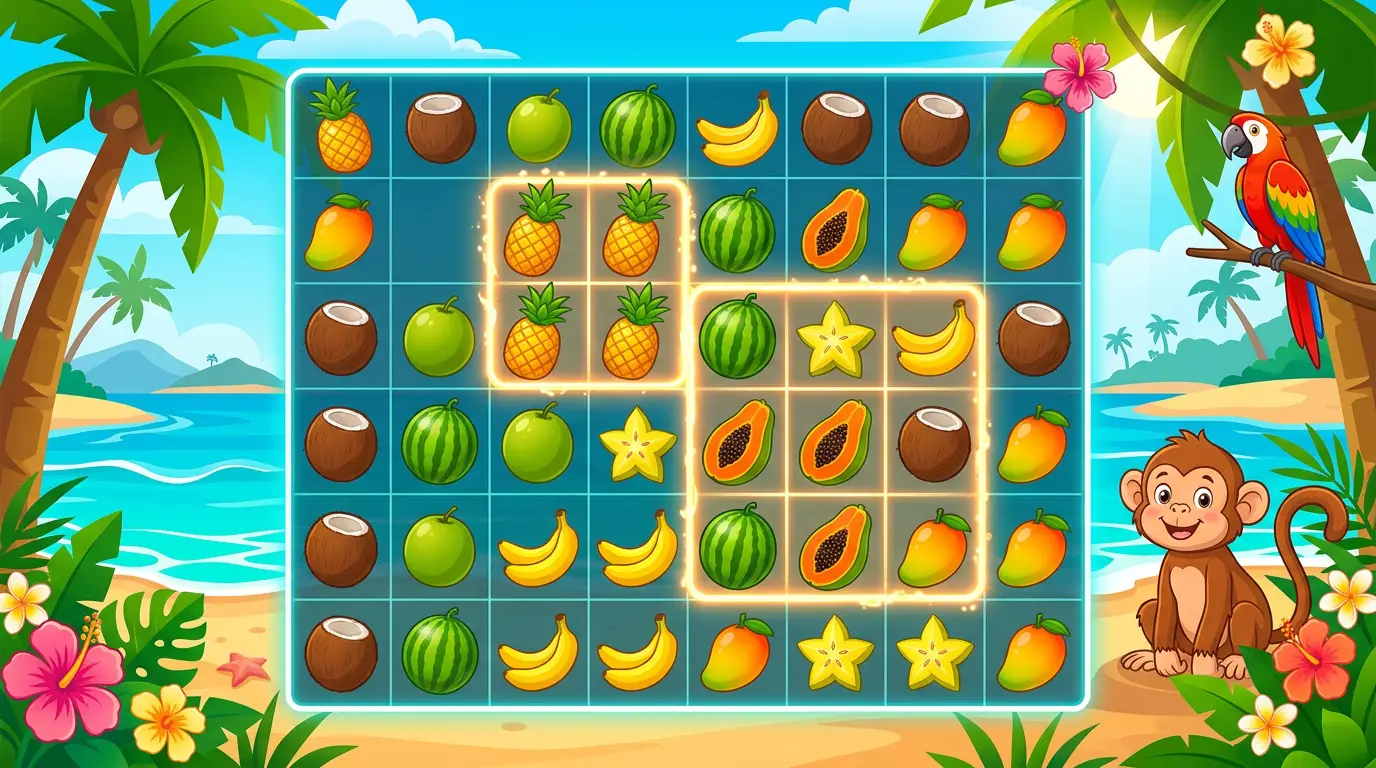
Hula Balua's playing area is a 6×6 grid of 36 cells. This is larger than the 5×3 layout used in most traditional slots, and the extra space is central to how the game's mechanics function. The grid needs room to accommodate big symbols of varying sizes and to allow merge chains to develop across multiple redrops.
There are no paylines. Instead, the game uses cluster pays: wins are formed when five or more symbols of the same type occupy adjacent cells - connected horizontally or vertically. Diagonal adjacency does not count. The size of a winning cluster determines the payout, scaled by the symbol's value.
Standard symbols occupy one cell (1×1). Big symbols occupy multiple cells simultaneously - 2×2 (four cells), 2×3 (six cells), 3×3 (nine cells), or larger configurations. When a big symbol is part of a winning cluster, all of its cells count. A 3×3 symbol adjacent to three 1×1 matching symbols forms a twelve-cell cluster - considerably larger than what seven individual symbols would normally produce.
| Symbol size | Cells occupied | Cluster contribution |
|---|---|---|
| 1×1 | 1 | Counts as 1 matching cell |
| 2×2 | 4 | Counts as 4 matching cells in any adjacent cluster |
| 2×3 or 3×2 | 6 | Counts as 6 matching cells |
| 3×3 | 9 | Counts as 9 matching cells |
| Larger | 9+ | All cells count; pays as one symbol type |
The grid fills from top to bottom after each redrop. New symbols enter from the top of the columns to fill the cells vacated by winning clusters. Non-winning symbols stay in place - they do not fall to fill gaps below them. This is the "sticky" aspect of the redrop mechanic, and it is why understanding grid positioning matters: a large premium symbol that was not part of any win in step one can become the anchor for a large cluster in step three if the surrounding positions fill favourably. Every mechanic is documented in full on the Hula Balua features page.
How a Single Spin Works - Step by Step
A single spin in Hula Balua involves more steps than a traditional slot. The sequence below covers what happens from the moment you press spin to when the final payout is displayed.
Initial drop
Symbols drop onto the 6×6 grid. Standard 1×1 symbols, big symbols (2×2, 3×3, larger), and scatter symbols can all land on this initial drop. The game evaluates the grid for merge opportunities and winning clusters before displaying any results.
Merge evaluation
If two or more identical big symbols of the same type are adjacent, they automatically merge into a single larger block before win calculation. Each merge increments the global multiplier by 1. Multiple simultaneous merges each add 1× to the multiplier. Elmo may appear at this point to create wild symbols.
Cluster wins calculated
After merges resolve, the game identifies all winning clusters (five or more adjacent matching symbols). These clusters are awarded their symbol value × cluster size payout. Winning symbols are marked for removal. The running total of wins for this spin is updated.
Redrop
Winning symbols are removed. Non-winning symbols stay in place (sticky). New symbols drop from above to fill the empty cells. The game evaluates the new grid for merges and wins. If new wins occur, the multiplier increments again and the process repeats from step 2. If no new wins occur, the sequence ends.
Final multiplier applied
When the redrop sequence ends (no new wins on the latest drop), the global multiplier is applied to the total accumulated wins for the entire spin sequence. The resulting amount is credited. The multiplier resets to 1× for the next spin.
Feature Flow - What Happens and When
Understanding the sequence of events within a single redrop chain helps you follow what is happening during a complex spin. This table maps each event type to its game effect and its impact on the global multiplier.
| Event | What happens | Multiplier effect | When it occurs |
|---|---|---|---|
| Big symbol lands | Occupies multiple grid cells as one unit | None (not yet) | Initial drop or any redrop |
| Merge event | Two adjacent identical big symbols fuse into one larger block | +1× per merge | Before win calculation, each redrop step |
| Elmo Redrop | Elmo walks across grid; creates wild symbols in path | None directly (enables more merges/wins) | Random during any redrop step |
| Winning cluster | Payout added to running total; symbols removed | None directly | Each redrop step after merges resolve |
| Contributing redrop | New symbols drop; new wins form | +1× per contributing step | After each winning cluster step |
| Scatter lands | Counted toward bonus trigger (3+ triggers Free Drops) | None | Initial drop or any redrop step |
| Sequence ends | No new wins on latest drop; final multiplier applied to total | Final accumulated value applied | End of redrop chain |

Entering the Bonus Round
There are three ways to enter the Free Drops bonus in Hula Balua. Understanding each helps you choose how to allocate your session budget.
Natural trigger
Land three or more scatter symbols during a single spin or redrop sequence. Scatters appearing on the initial spin and on subsequent redrops all count toward the trigger within that sequence. Three scatters trigger at minimum; each additional scatter adds more free drops. No extra cost - this is the standard route to the bonus.
X-iter™ Free Drops purchase
Where regulation permits, pay a fixed multiple of your base stake (typically 80-120×) to enter Free Drops immediately. The game enters the bonus round as if three scatters had landed naturally. This is a guaranteed feature entry at a known cost. Not available in all jurisdictions - the X-iter™ menu will show what is available at your operator.
X-iter™ Super Bonus purchase
Pay a higher fixed multiple (typically 150×+ your stake) to enter Super Bonus directly, bypassing standard Free Drops entirely. The premium symbol set is active from the first free spin. This is the most expensive X-iter™ option but gives immediate access to the highest-potential bonus mode. Restricted in many jurisdictions.
Which entry method makes sense depends on your session budget relative to the cost. For most players with a standard session budget, natural triggers via base-game play are the appropriate route. X-iter™ bonus buy is a sensible option only when the purchase cost is a manageable fraction of your total budget - not the majority of it. For the full picture on RTP, volatility, and bankroll sizing, see the dedicated guide.
How to Read the Grid During Play
One of the skills that develops with Hula Balua experience is learning to read the grid state - assessing before the next drop whether conditions are favourable for a large redrop sequence. This does not change the game's randomness, but it does help you understand why certain spins produce large wins and others produce nothing.
Look for these grid conditions as indicators of potential:
- Adjacent big symbols of the same type. Two 2×2 premium masks one cell apart are one redrop away from merging. A spin that positions these symbols near each other without immediately triggering a win is still valuable - the next drop may bring them together.
- Large blocks in central positions. Symbols in the middle of the grid have more adjacency opportunities than symbols at the edges. A 3×3 block in the centre can connect to matching symbols from four directions; an identical block at the corner connects from only two.
- Scatter positions early in a redrop chain. If scatters have landed on the initial spin without completing the trigger count, further redrops may add more. A two-scatter initial drop is one redrop away from triggering the bonus if the next drop adds a third.
- Rising multiplier. A multiplier of 5× or above with active redrops still continuing is a signal that the current sequence has compound win potential. The next winning cluster is worth 5× its face value before any further multiplier growth.

What to Do After a Big Win
Large wins in high-volatility slots produce a strong psychological response - the urge to continue playing and "see what else the game can do." This response is predictable and is the mechanism behind many sessions that turn from winning to losing. Managing it deliberately is one of the most important skills for playing Hula Balua sustainably.
After any win that substantially exceeds your stake-per-spin - particularly a bonus win that returns 100× or more - pause before continuing. A five-minute break is enough to let the emotional response moderate. During that break, consider: have you reached your pre-set win target? If yes, the rational decision is to end the session. Have you already recovered your session losses and then some? If yes, banking a portion of the win and continuing with the remainder on a new mental budget is a structured approach.
Practically: use the casino's cashier or balance display to note your current total. Decide what portion you want to treat as "banked" - mentally or actually withdrawing it - before your next session. Many experienced players withdraw significant wins immediately after a session ends, not between sessions, to remove the temptation to re-stake them in the same visit.
The game has no memory of your previous wins. A large bonus payout does not affect the probability of the next bonus trigger. Playing with this awareness prevents the common error of assuming the game "owes" continued good fortune after a big win.
Pre-Session Checklist
Use this checklist before each real-money Hula Balua session. It takes less than two minutes and is the most reliable way to prevent the common errors that reduce session quality.
| ✓ | Session budget confirmed | Total amount willing to lose in this session decided before loading the game. |
| ✓ | Stake sized correctly | Stake per spin set at 1-2% of session budget. At £50 budget: £0.50-£1.00 per spin. |
| ✓ | Win target set | A specific win amount that defines a "good session" - if reached, session ends. |
| ✓ | Time limit set | Maximum session duration decided (30-45 minutes recommended). Phone timer started. |
| ✓ | In-game RTP verified | Opened help file in game at this operator; noted the active RTP figure. |
| ✓ | Bonus terms checked (if applicable) | If playing with a welcome bonus: wagering requirement, max bet, and expiry understood. |
Frequently Asked Questions
How many paylines does Hula Balua have?
Hula Balua does not use traditional paylines. Instead, it uses a cluster-pays system where wins are formed by groups of five or more matching symbols occupying adjacent cells on the 6×6 grid, connected horizontally or vertically. There are no fixed lines - any adjacent cluster of the same symbol type anywhere on the grid forms a win.
What is the minimum and maximum stake in Hula Balua?
Bet limits vary by operator. Each casino that carries Hula Balua sets its own minimum and maximum stake limits within the range ELK Studios permits. Open the game at your chosen casino and check the bet control settings before playing. Do not assume the limits match those at a different operator.
How do I know if a spin produced a big win?
The global multiplier display and the win counter visible during the redrop sequence tell you how a round is developing. A large global multiplier (10× or above) combined with active redrops and merge events is the pattern that precedes large wins. The final win amount is displayed at the end of the complete redrop sequence - after all merges and redrops have resolved.
Can I use autoplay in Hula Balua?
Autoplay availability depends on your jurisdiction and the specific operator. Some regulated markets (notably the UK) have restricted or removed autoplay from slots. At operators where autoplay is available, it is typically configurable with loss limits and single-win limits. If autoplay is important to your play style, verify its availability at your chosen casino before depositing.